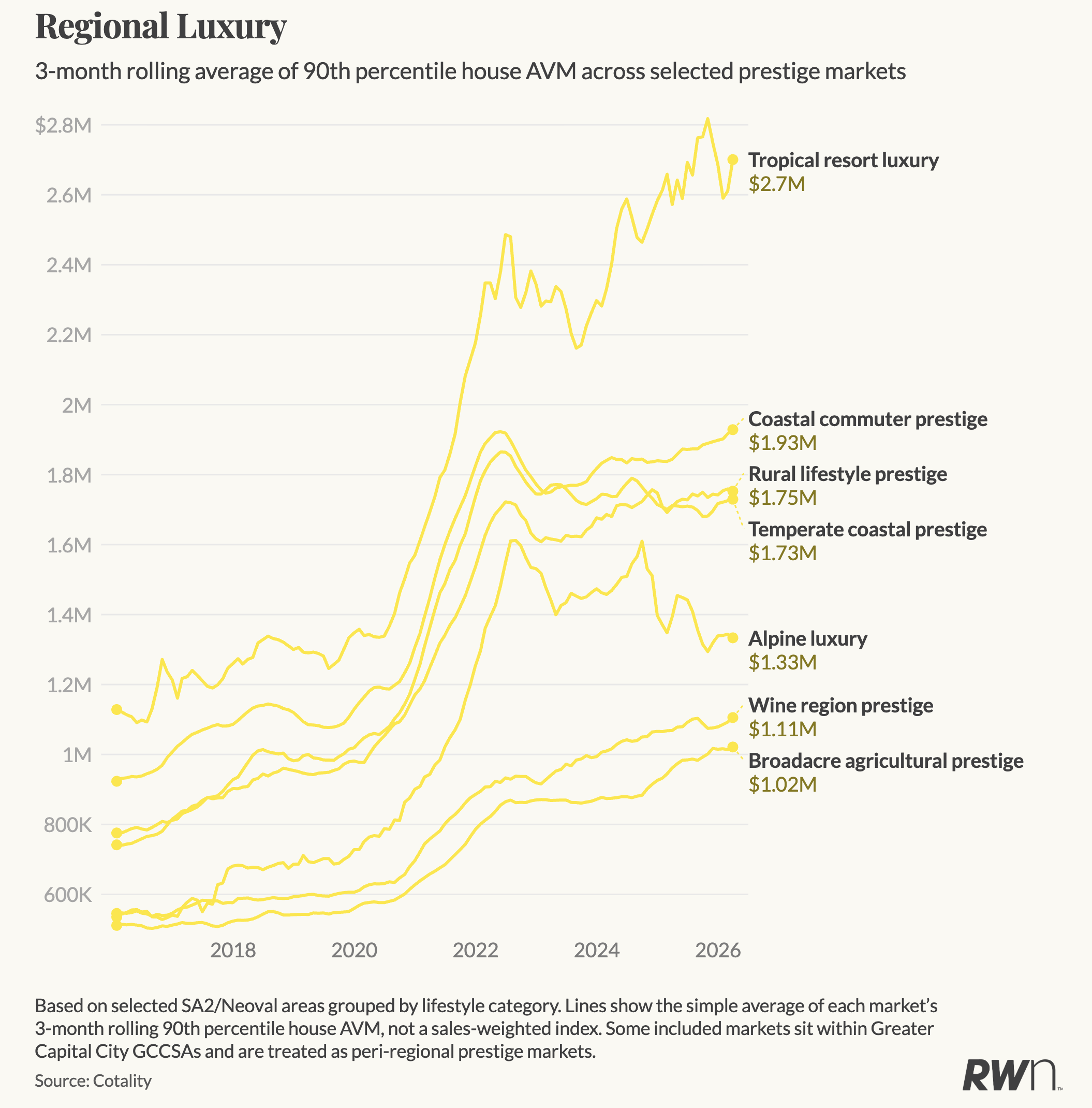
Australia’s regional luxury housing market is often discussed as though it were a single market. In reality, prestige markets are driven by very different buyer groups and demand drivers. Some are influenced by tourism, others by migration, lifestyle preferences or agricultural wealth. Over the past decade, these different forces have produced very different outcomes. Most notably, tropical resort markets have emerged as the strongest-performing luxury precinct, while coastal commuter markets have recently overtaken Australia’s traditional temperate coastal prestige markets.
To better understand these differences, we developed a regional luxury precinct classification and analysed house values across a selection of Australia’s best-known prestige regional markets.
Rather than relying on median house prices or individual sales, this analysis uses the 90th percentile house automated valuation model (AVM) for each SA2, providing a consistent measure of the premium end of each market. We then calculated a three-month rolling average and averaged the series across each precinct to produce representative trends over time.
Unlike a sales-weighted index, this approach gives each selected market equal weight, allowing us to compare how different types of luxury markets have evolved regardless of transaction volumes.
The classification divides regional markets into seven distinct luxury precincts.
Defining the luxury precincts
Temperate coastal prestige (9 SA2s) includes established premium coastal communities such as Byron Bay, Portsea and Lorne–Anglesea. These are mature prestige markets characterised by constrained supply, strong owner-occupier demand and enduring lifestyle appeal.
Coastal commuter prestige (8 SA2s) includes premium coastal markets within commuting distance of capital cities, including Mount Martha, Mornington, Barwon Heads, Torquay and Kiama. These markets combine coastal amenity with access to metropolitan employment and wealth.
Tropical resort luxury (6 SA2s) captures resort-focused markets including Port Douglas, Palm Cove, Hamilton Island, Broome, Noosa Heads, Sunshine Beach, Mermaid Beach–Broadbeach, Broadbeach Waters, Main Beach and Paradise Point–Hollywell, where demand is more closely linked to tourism and discretionary spending.
Rural lifestyle prestige (11 SA2s) includes markets such as Bowral–Mittagong, Moss Vale, Daylesford, Macedon and Tamborine Mountain, where buyers are typically seeking larger homes, acreage and lifestyle properties.
Wine region prestige (7 SA2s) incorporates vineyard regions including Tanunda, McLaren Vale, Healesville–Yarra Glen and Pokolbin, combining prestige housing with renowned wine-producing districts.
Alpine luxury (4 SA2s) includes Thredbo–Perisher, Jindabyne, Falls Creek and Mount Buller.
Broadacre agricultural prestige (5 SA2s) comprises larger rural holdings in markets such as Scone, Orange, Mudgee and Mansfield.
Tropical resort markets have pulled away
The standout performer over the past decade has been the tropical resort luxury precinct.
Premium values accelerated sharply during the pandemic as affluent buyers sought resort-style properties and holiday homes. While the segment has experienced more volatility than most, it has continued to establish new highs and now sits comfortably above every other luxury precinct.
The strong performance reflects the exceptional growth recorded across many of Australia’s premium resort markets over the past decade, particularly those concentrated along Queensland’s coastline. While these markets have experienced greater volatility than some other luxury precincts, they have consistently established new highs and now sit comfortably above every other regional luxury category.
Coastal prestige remains remarkably resilient
Temperate coastal and coastal commuter prestige markets have also delivered exceptional long-term performance.
Both experienced strong price acceleration through 2020 and 2021 as remote work, wealth accumulation and changing lifestyle preferences increased demand for premium coastal housing. Although prices moderated as interest rates rose, neither segment experienced a significant reversal.
Temperate coastal and coastal commuter markets tracked each other closely for much of the past decade. More recently, however, coastal commuter markets have edged ahead. The shift suggests buyers continue to place a premium on locations that combine a coastal lifestyle with convenient access to major cities, reinforcing the appeal of markets that offer both lifestyle and connectivity.
Alpine markets remain the most cyclical
No luxury precinct illustrates the pandemic cycle more clearly than alpine markets.
Values climbed rapidly through 2021 and early 2022 before correcting more sharply than any other precinct as borrowing costs increased and discretionary spending softened. Although values remain well above pre-pandemic levels, alpine markets continue to display considerably more volatility than other luxury categories.
The combination of relatively small markets, limited transaction volumes and discretionary demand makes alpine precincts particularly sensitive to changes in buyer confidence.
Lifestyle migration has had a lasting impact
Rural lifestyle prestige markets also experienced significant growth during the pandemic as flexible working arrangements encouraged buyers to prioritise space and lifestyle. While growth has moderated, these markets have retained most of their gains and continue to perform strongly.
Wine region prestige markets have followed a different trajectory. Rather than experiencing a sharp pandemic-driven surge, they have delivered steadier appreciation over the decade with relatively modest corrections. These markets appear to behave more like established prestige markets than high-growth lifestyle markets.
Broadacre agricultural prestige has been steadier again. Growth has been consistent but less pronounced than in the lifestyle-focused precincts, reflecting the influence of agricultural land values alongside residential demand.