Nerida Conisbee
Ray White Group
Chief Economist
Something interesting happened in Sweden in early May and it had nothing to do with Eurovision, IKEA or ABBA.
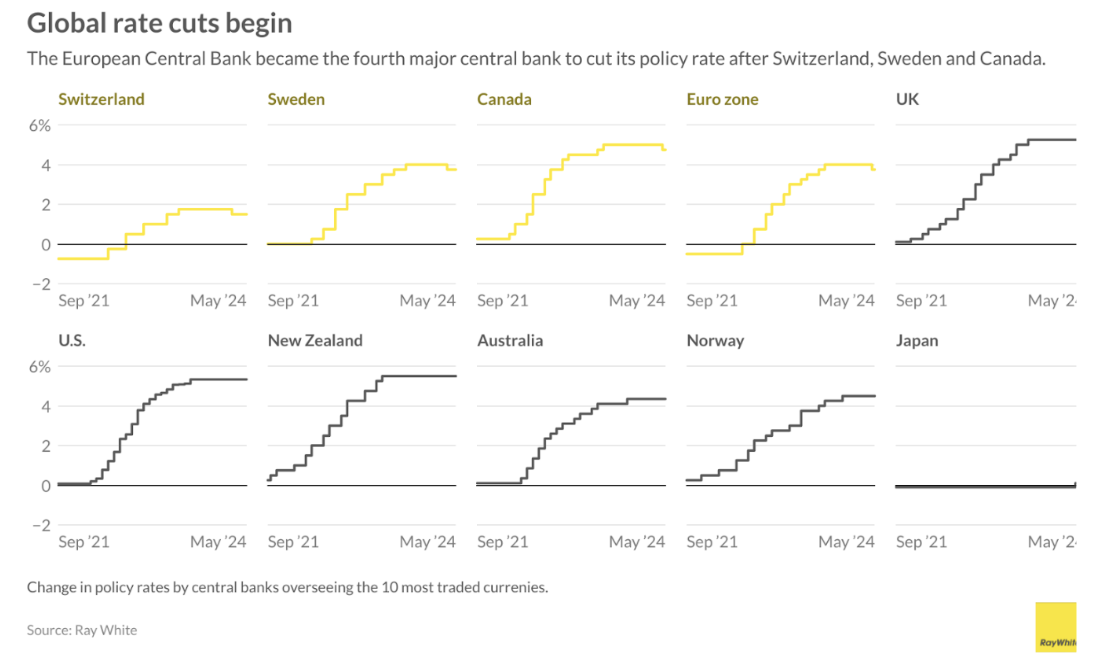
While Switzerland cut in March, Sweden was the first country in this cycle to cut interest rates following very high inflation. This was of interest but was relatively under reported, primarily because Sweden, while a successful economy, isn’t necessarily a global economic superpower. Global interest rate commentary became a bit more interesting on June 5 when Canada cut interest rates and then the next day the European Central Bank cut. 
Successively, we are now starting to see interest rate cuts occurring. While the dominant commentary has been “higher for longer”, it has now switched to “less high for longer”. Australia will follow, likely sooner rather than later and increasingly likely this year. This month however, the Reserve Bank of Australia decided to hold.
Australian inflation is coming down but is remaining sticky. April inflation came in at 3.6 per cent, still above the 2-3 per cent the RBA aims for. While inflation remains strong, our economy is less so. While we are not likely to head into recession, we are skating very closely. A recession is defined as two quarters of declining Gross Domestic Product (GDP). Our GDP hasn’t declined but the last quarters saw just 0.3 per cent and 0.1 per cent growth.
A cut is still possible this year. As we saw in Europe, rates can be cut before reaching the target rate. European inflation is currently at 2.4 per cent and the European Central Bank target is two per cent. Even if we don’t hit three per cent on the mark, it is possible that the RBA will cut. Unfortunately for many mortgage holders, this cut was not this month.